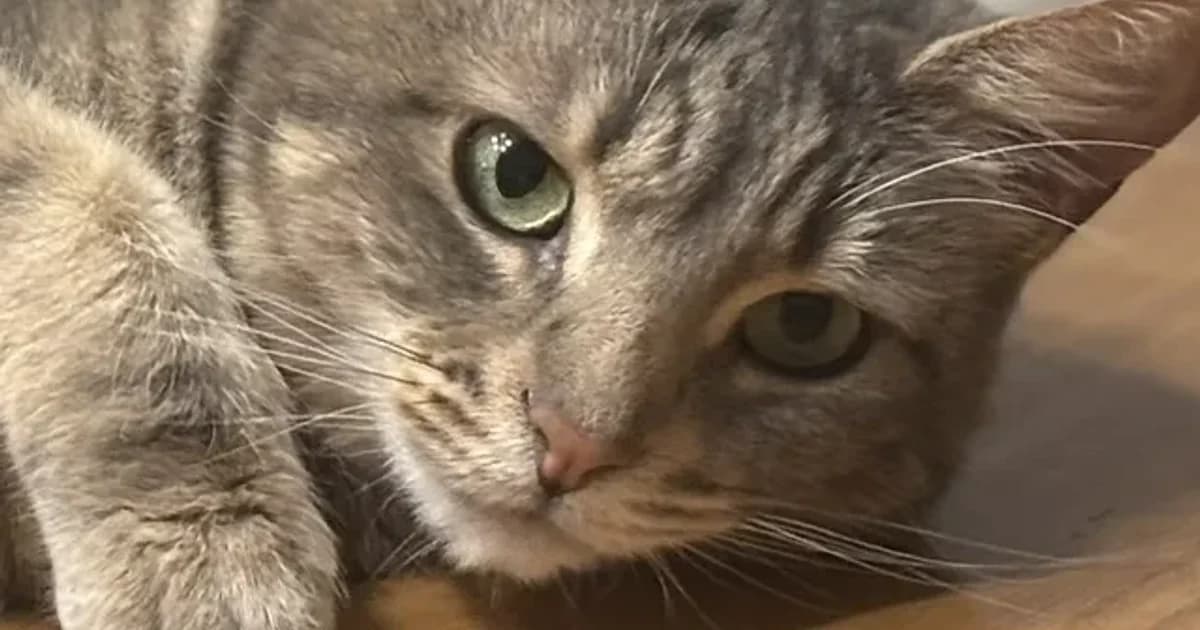
Cats are lower-maintenance boarders than dogs (no temperament trials, no group play assessments) but cat boarding is not a paperwork-free zone. Facilities that board cats have a firm list of vaccine and record requirements, and "he's an indoor cat" doesn't waive any of it. Here's what you'll be asked for, why, and how to get it together before your trip instead of during it.
For current background, consult AAHA feline vaccination recommendations. Facility policies and local requirements can differ; confirm the rules that apply to your pet.
The two vaccines to confirm with your facility
Rabies
Rabies requirements for cats vary by jurisdiction and can apply to indoor cats. Your veterinarian can confirm the applicable schedule and documentation. Ask the facility for its policy, and check that the certificate covers the planned stay.
FVRCP
FVRCP covers feline viral rhinotracheitis, calicivirus, and panleukopenia. Your vet determines the schedule for the product and your cat’s age and health. Kittens commonly receive doses every 3–4 weeks through 16–20 weeks of age. Adult schedules vary. Ask the facility what vaccination interval it accepts and ask your vet whether any update is appropriate before boarding.
The variable one: FeLV (feline leukemia)
FeLV is where cat boarding requirements genuinely split:
- Some facilities require a current FeLV vaccination, particularly where cats from different households may interact.
- Some require a negative FeLV/FIV test instead of, or in addition to, vaccination. Ask how recent the test must be and whether first-time boarders need one.
- Some recommend it according to risk. Your vet’s plan also depends on age and possible exposure. FeLV vaccination is a core recommendation for kittens and young cats under one year, while the decision for older cats depends on risk.
FeLV can spread through close contact, including grooming, shared bowls, and bites. Ask whether cats from different households mix, and confirm the facility’s FeLV vaccination and testing rules rather than guessing from its room layout. An initial FeLV vaccine series uses two doses, 3–4 weeks apart. Your vet should test your cat’s FeLV status before vaccination and assess the exposure risk.
"My cat never goes outside", why it doesn't change the list
This is an understandable misconception in cat boarding, so let's be direct: indoor-only status does not automatically exempt cats from local rabies laws or a facility's vaccine requirements. Three reasons:
- Local law can apply indoors. Ask your veterinarian or local animal-health authority about the rule where you live.
- Boarding changes exposure. Your cat may never meet another animal at home. In a facility, other cats and shared equipment create different risks. Ask your vet about protection against the diseases covered by FVRCP.
- Facility policy is separate. Confirm its written requirements and any exemption process before booking.
If your indoor cat has never been vaccinated (it happens, especially with cats who haven't seen a vet in years) tell the facility early. You'll need a vet visit, and some vaccines need lead time (below). Every facility has seen this before; what they can't fix is discovering it at drop-off.
Timing rules: the other way cats get turned away
Planning rule: book any needed vet visit at least two weeks before drop-off. If your cat needs an initial vaccine series, start at least a month ahead and ask your vet whether you need longer. These are planning buffers, not a guarantee of admission: the vaccine product, prior doses, and facility’s waiting period determine the actual dates. Get the cattery’s written policy before booking the visit.
Some cat facilities ask for vaccines a set number of days before admission, for example 7–14 days. Confirm the facility's actual interval and ask your vet how it applies to your cat's previous doses and vaccine products. Two timing questions deserve an early call:
- The two-dose start. If your cat needs a first FeLV series (two doses, 3–4 weeks apart), starting a week before your trip doesn't work. Anything "initial series" needs a month of runway.
- The overdue booster. Ask your vet how to handle a lapse. Do not assume that an overdue rabies booster always creates a new waiting period: CDC guidance distinguishes initial doses from boosters in animals with vaccination history, and local rules still apply.
Safe approach: pull the records the day you book travel, and treat anything expiring before or during the stay as a vet appointment to make now. Our broader guide to getting your pet's records ready for boarding walks through the full timeline.
What proof do facilities accept?
Cat boarding proof rules mirror dog boarding, with the same trap:
- Bring or send: the rabies certificate and a vaccine summary from your vet showing vaccine names, dates given, and due dates.
- Send it early. Ask the cattery or veterinary boarding facility to review your records when you reserve. Confirm whether it accepts a clear photo or scan by email.
- The invoice problem: a paid receipt that says “exam + vaccines” may not show which vaccines were given or when they expire. Ask your vet’s office for the actual vaccine record and how long it will take to provide it.
- Records at a different vet than usual? If your cat was vaccinated at a low-cost clinic, a shelter, or a previous vet, ask that provider to email the record to you. Then send it to the boarding facility for review.
Other things facilities commonly ask about
- Flea prevention: many facilities require cats to be on current flea prevention, and some apply or require a treatment on arrival if they find fleas (sometimes at your cost).
- Spay/neuter status: rarely a hard requirement for solo-housed cats, but unneutered males are sometimes restricted or housed separately, expect the question on the intake form.
- FeLV/FIV test results: as above, ask when booking.
- Health and behavior notes: recent appetite changes, medications, and how your cat handles strangers all go on the intake form. Cats on daily medication board fine at most facilities (especially vet-affiliated ones), but there may be an administration fee, and the medication must arrive in its original labeled container.
- A vet visit "health certificate": not usually required for domestic boarding, but some facilities ask for a vet exam within the last 12 months. If yours does, it's another reason to check the list early.
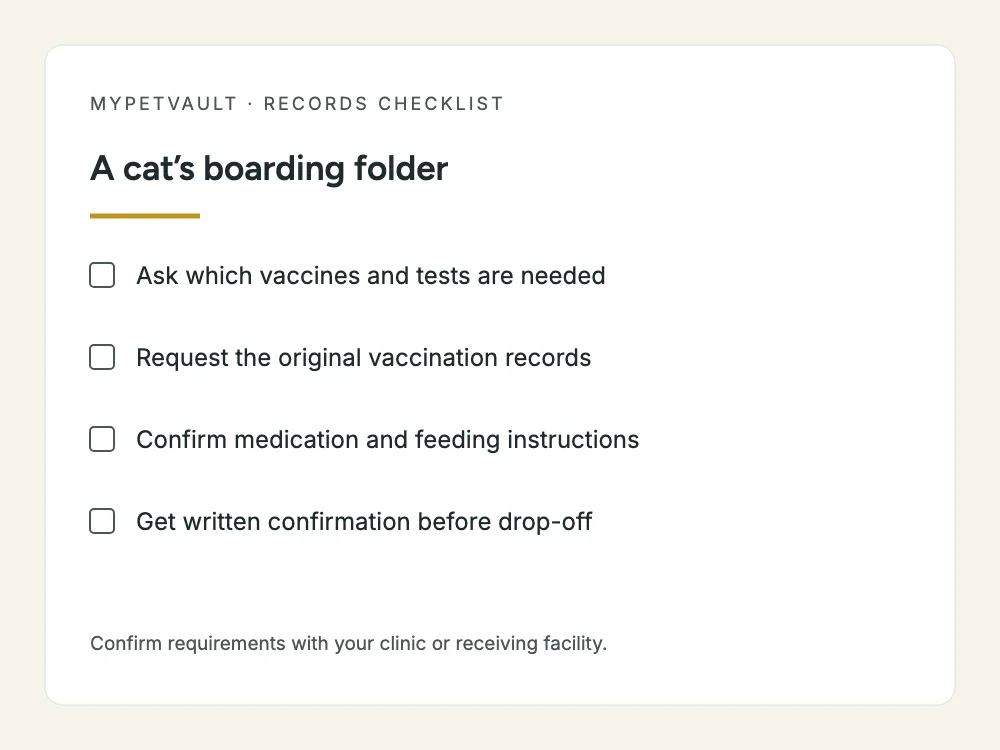
Your cat boarding records checklist
- Rabies: current, certificate obtained, valid through your pickup date
- FVRCP: current within the facility’s window (confirm: 1-year or 3-year rule?)
- FeLV: facility’s stance confirmed (vaccine required / test required / recommended only)
- FeLV/FIV test: done within the facility’s window, if required
- All vaccines meet the facility’s exact pre-check-in waiting period
- Flea prevention current if the facility requires it
- Records emailed to the facility in advance and confirmed
- Medications in original labeled containers, with written instructions
- Vet phone number and your emergency contact on the intake form
Related guides
Boarding a dog instead? See dog boarding vaccine requirements.
Can't find the rabies certificate at all? Here's how to replace a lost rabies certificate.
Written for pet owners in the US & Canada. Rules and fees vary by location, so confirm the details with your clinic.
Common questions
Do indoor cats really need vaccines to board?
Indoor-only status does not automatically exempt your cat from local rabies laws or boarding policies. Facilities commonly ask for FVRCP as well as rabies documentation. Confirm the written requirements and ask your vet which vaccines and dates apply to your cat.
What's the difference between FVRCP and FeLV requirements?
FVRCP covers the core feline respiratory and panleukopenia vaccines commonly requested for boarding. FeLV requirements vary: some facilities ask for vaccination, some ask for a recent negative FeLV/FIV test, and some recommend vaccination according to risk. Ask which rule applies when you book; a test or two-dose series needs advance planning.
How close to the stay can my cat be vaccinated?
Confirm the facility's written interval; some use a 7–14-day waiting period, while others have different policies. Your vet can explain the timing for the actual product and vaccination history.
My cat's rabies vaccine expired last month. Can she still board?
Contact your vet about the booster and ask the facility when it can accept your cat. An overdue booster is not automatically treated like a first vaccination; prior documentation and local rules matter.
Will a boarding facility accept a photo of the vaccine record?
Many facilities accept a clear photo or scan of the rabies certificate and vaccine summary, especially when sent in advance. Ask yours to confirm. The record should show vaccine names and validity dates; a payment receipt alone may not contain the information it needs.
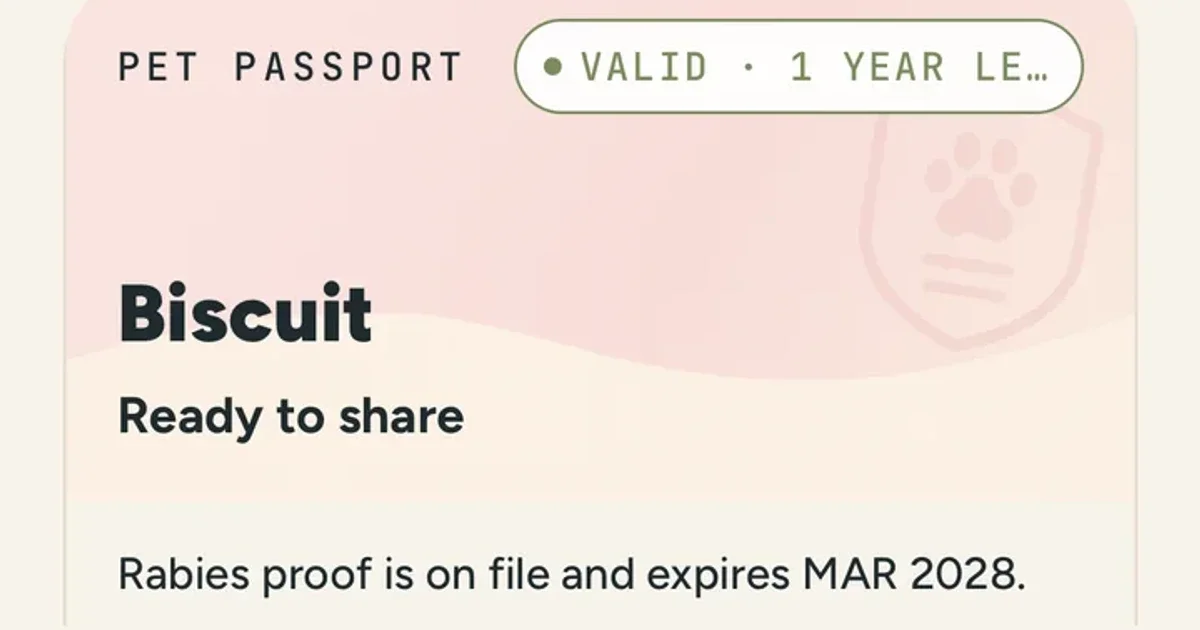
Cat records have a way of living at three different vets, a shelter, and a filing cabinet simultaneously. MyPetVault is a pet record app that keeps them in one Pet Passport per cat. Upload the rabies certificate and the Passport is ready to share with a cattery, sitter, or new vet in seconds. The first pet is free; get MyPetVault here and do the paperwork once, while you're not packing.
Tommy Cao, founder of MyPetVault
Sources & further reading
Keep reading
 How to Prepare Your Dog's Records for Boarding: The 3-Week Prep Plan8 min read
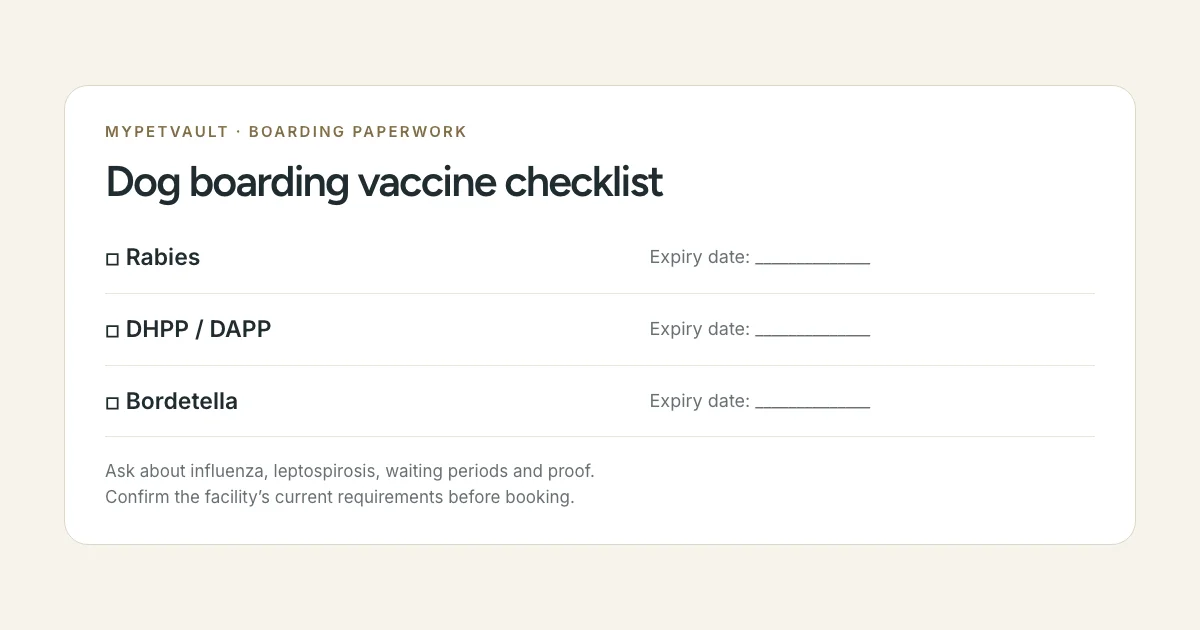 What Vaccines Does a Dog Need for Boarding? The Complete Requirements Checklist8 min read