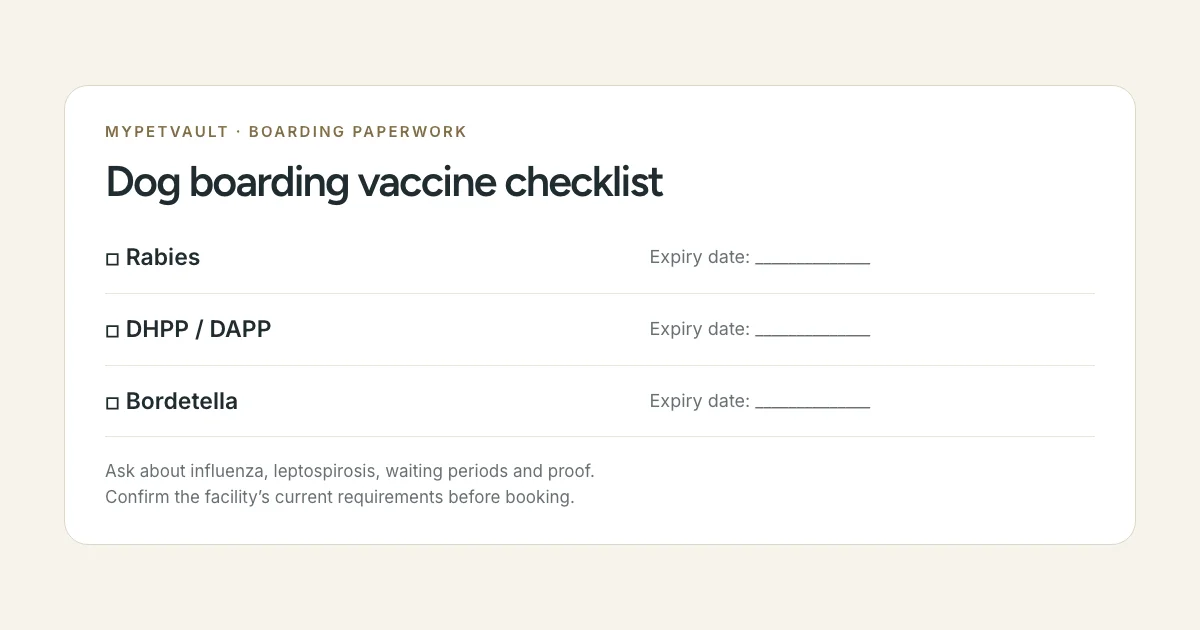
| Vaccine | What boarding facilities commonly ask for | Check before booking |
|---|---|---|
| Rabies | Current vaccination and the signed certificate | Valid through pickup; local rules and any waiting period |
| DHPP / DA2PP | Current distemper/parvo combination record | Accepted booster interval and listed components |
| Bordetella | Often required for group boarding | 6- or 12-month window; product-specific waiting period |
| Canine influenza | Required by some facilities | Whether both types are covered; time for an initial two-dose series |
| Leptospirosis | Facility policy varies; discuss vaccination with your vet | Your dog’s plan and the facility’s written list |
You're booking the trip, you've found a boarding facility with space, and then comes the email: "Please send proof of current vaccinations." If you're like most owners, the records are in a drawer, an old email thread, or a portal you haven't opened since your dog was a puppy. Here's what facilities ask for, what counts as proof, and the timing rules that quietly get dogs turned away.
For current background, consult AAHA canine vaccination recommendations. Facility policies and local requirements can differ; confirm the rules that apply to your pet.
The core three: confirm your facility’s requirements
Rabies
Rabies requirements depend on local law, vaccine labeling, and the facility. Ask your vet which dates apply to your dog, including any recognized medical exemption, and ask the boarding facility which documentation it accepts. The certificate and its validity dates matter more than remembering roughly when the shot happened.
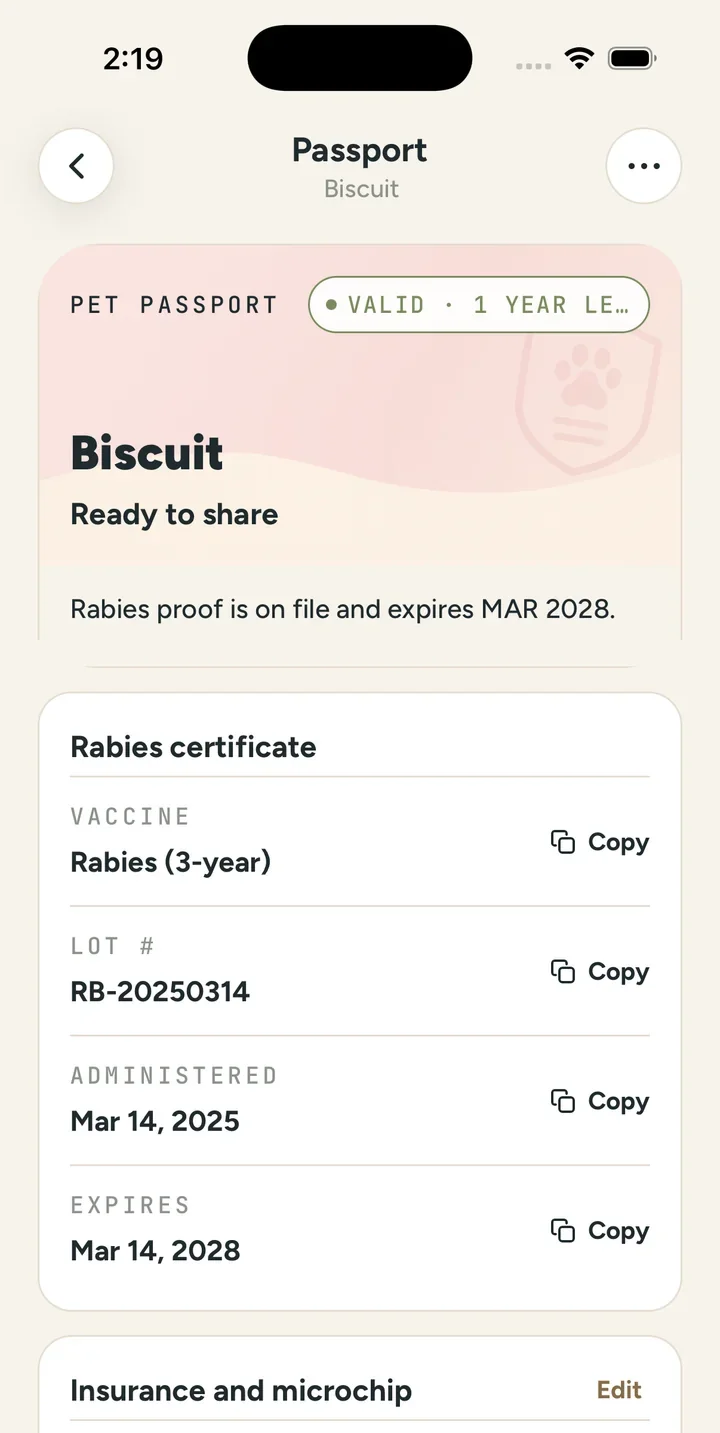
Ask for the actual rabies certificate, not just a receipt. In many states it's a specific document with the vaccine lot number, the administering vet, and the expiration date, the document facilities ask for by name.
DHPP (also listed as DA2PP or DAPP)
DHPP, DA2PP, and DAPP are common abbreviations for combination vaccines, but the exact components can vary by product. Ask your clinic to identify the components and due dates on the record, and have the facility confirm that this meets its policy. Your veterinarian sets the vaccination plan; a booking checklist does not replace it.
Bordetella (kennel cough)
Bordetella can cause check-in surprises for two reasons:
- Validity windows vary. Some facilities accept a Bordetella vaccine given within the last 12 months; others require it within the last 6 months. Your dog can be current by your vet’s schedule and still fall outside your kennel’s rules. Confirm the written policy when you book.
- It comes in three forms: intranasal, oral, and injectable. Their dosing and timing differ. Ask your vet which product your dog received and ask the facility about its waiting period.
Commonly required or recommended add-ons
Canine influenza (H3N2 / H3N8)
Some boarding facilities require canine influenza vaccination, especially where exposure risk is a concern. The initial series is two doses, 2–4 weeks apart, so a first-time vaccination needs more lead time than a single appointment. Confirm the admission deadline with the facility and the schedule with your veterinarian.
Leptospirosis
Leptospirosis vaccination is now a core recommendation in the AAHA canine guidelines, even though boarding facilities may not list it among their admission requirements. Ask your veterinarian about your dog's plan and ask the facility about its separate paperwork policy. A facility's shorter checklist is not a complete preventive-care plan.
What about titers?
A small number of facilities accept a titer test (a blood test showing antibody levels) in place of a booster for some vaccines. Most do not, and almost none accept one in place of rabies where the law requires vaccination. If you prefer titers, ask before you book, not at check-in.
The timing trap: vaccines given too close to the stay
This is the part nobody tells you until it's too late. Even a perfectly current vaccine can be rejected if it was given too recently.
Some facilities specify a waiting period such as 7–14 days, but there is no universal boarding interval. The vaccine product, prior doses, your veterinarian's advice, and the facility's policy all matter. Get the exact deadline in writing before arranging an appointment.
A published example: Apollo Kennels requires vaccination at least seven days before boarding and Bordetella within six months of the reservation. Another facility may use different deadlines, so confirm the policy for your booking.
The safe rule: as soon as you know your travel dates, check the records. If anything needs updating, book the vet visit for at least two weeks before drop-off, earlier if your dog needs a two-dose series (flu or lepto), which means starting 4–6 weeks out.
What counts as proof?
Facilities want documentation, and not all paperwork is equal:
- Best: the rabies certificate and a vaccine summary from your vet showing each vaccine, the date given, and the expiration or due date.
- Usually accepted: a clear photo or scan of the above, emailed ahead of time.
- Often rejected: a paid invoice or receipt alone. Invoices prove you paid for something; they frequently don't list expiration dates or clearly tie the vaccine to your dog. A facility may reject them, the document may not answer their question.
- Rarely accepted: your word, or a portal screenshot with no dates.
Send proof before your trip, not at drop-off. Most facilities review records in advance and flag gaps while you still have time to fix them. That habit gives you time to resolve documentation gaps.
Puppies, seniors, and special cases
Puppies are held to a different standard. Most facilities won't board puppies until they've completed their initial vaccine series (typically around 16 weeks) plus rabies, with a waiting period after the final round. Some board younger puppies in separate areas; ask rather than assume.
Senior dogs may need an individualized vaccination plan. Ask your veterinarian about medical concerns and whether any exemption is appropriate under local rules. Then ask the facility whether it accepts the documentation; do not assume age alone changes its admission policy.
Your pre-boarding vaccine checklist
Run through this the day you book, not the day you pack:
- Rabies: current, certificate in hand, valid through your pickup date
- DHPP/DA2PP: current within the facility’s window, with the vaccine components confirmed
- Bordetella: given within the facility’s window (check: 6 months or 12?)
- Canine influenza: required? If yes and never given, allow time for the two-dose series
- Leptospirosis: your vet’s vaccination plan and the facility’s requirements confirmed
- Every vaccine meets the facility’s exact pre-check-in waiting period
- Records sent to the facility in advance and confirmed received
- Flea/tick prevention current if the facility requires it
- Vet’s phone number and your emergency contact on the booking
If any box fails, you still have time. That’s the point of checking early. For a fuller walk-through of getting everything together, see our guide to how to prepare your pet's records for boarding.
What happens if you're missing one?
It depends on how much time you have:
- Weeks out: book the vet visit. Many gaps can be resolved with time.
- Days out: call the facility. Ask whether you can still meet its vaccination and waiting-period rules, or whether you need another care arrangement.
- At check-in: be ready for the facility to decline admission if its requirements are not met. Call ahead so you have time to arrange other care.
Don't cancel in a panic before calling: a pet sitter, or a vet's boarding ward (some clinics board and can vaccinate in-house), are real fallback options. All of them are easier a week out than an hour out.
Related guides
Boarding a cat instead? See cat boarding requirements.
Lost the certificate itself? Here's how to replace a lost rabies certificate.
Written for pet owners in the US & Canada. Rules and fees vary by location, so confirm the details with your clinic.
Common questions
How long before boarding should my dog be vaccinated?
Ask your facility for its exact waiting period and your vet for the appropriate schedule. Some facilities specify 7–14 days, while an initial two-dose series can need more lead time. Start checking several weeks before travel rather than relying on a universal interval.
Is Bordetella required every 6 months or every 12 months for boarding?
Both rules exist. Some facilities require a Bordetella booster within the last 6 months; others accept 12. Your vet’s annual schedule does not settle it; the facility’s policy does. Check before you book, because an unexpected timing rule can disrupt a booking.
Can I just bring my vet invoice as proof of vaccination?
Often, no. Invoices frequently omit expiration dates and do not always clearly list which vaccines were given to which pet. Ask your vet for the rabies certificate and a vaccine summary showing dates given and due. Confirm that the facility accepts the documents before check-in.
My dog is a senior and my vet stopped some boosters. Can he still board?
Possibly. Ask your vet about your dog’s vaccination plan and any recognized medical exemption under local rabies rules. For other vaccines, some facilities accept a letter explaining the medical reasoning, but they are not obligated to. Call ahead and get acceptance in writing.
What if my dog's vaccines expire during the boarding stay?
Confirm that each vaccine stays valid through your pickup date. If a due date falls during the stay, ask your vet about the booster and ask the facility about its pre-check-in waiting period. Do this before travel so there is time to meet both requirements.
Nobody should have to reconstruct their dog's vaccine history from a drawer, an inbox, and a prayer the night before a trip. MyPetVault is a pet record app that keeps each certificate in a Pet Passport you can pull up in seconds. Upload the rabies certificate and the Passport is ready to share with a kennel, groomer, or vet whenever they ask. The first pet is free; download MyPetVault here before your next booking, not during it.
Tommy Cao, founder of MyPetVault
Sources & further reading
Keep reading
 How to Prepare Your Dog's Records for Boarding: The 3-Week Prep Plan8 min read
 The Dog Daycare Application Checklist: Records, Evaluations, and What Gets Dogs Turned Away8 min read