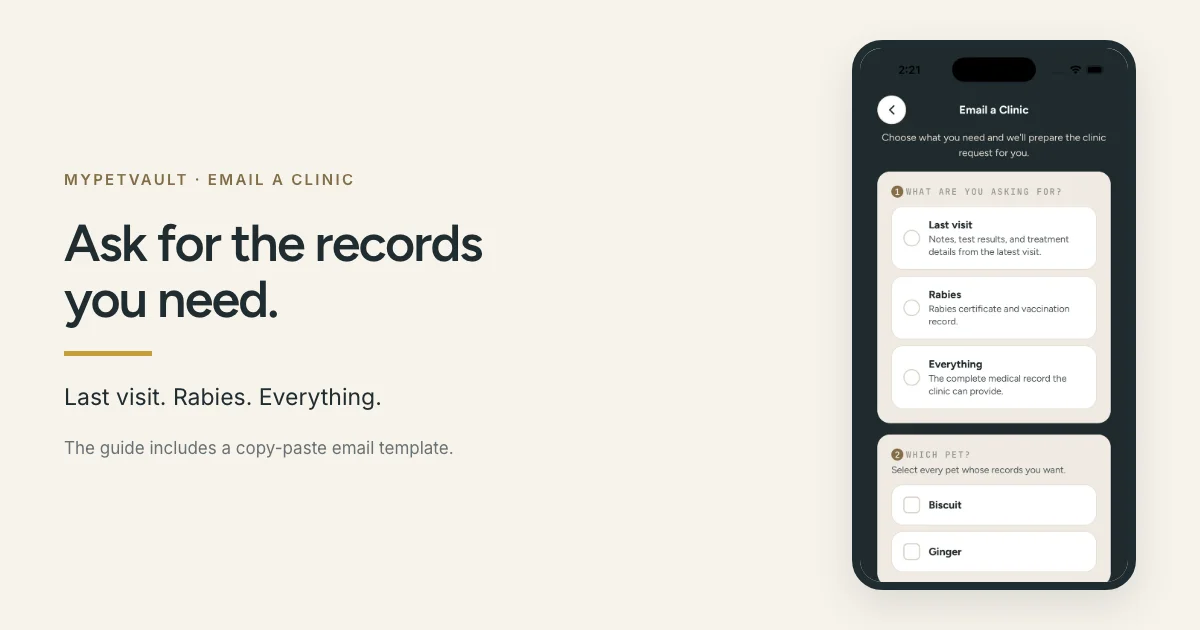
Copy this records-request email
Send this to the clinic's front-desk or records email. For more than one pet, send a separate request for each; names repeat inside clinics, and combined files get charted under the wrong animal.
Copy and adapt this records-request email
Subject: Records request for [Pet's name]: complete medical records
Hello [Clinic name] team,
I am requesting a complete copy of the medical records you hold for my pet.
Pet: [Name], [species/breed], [age or date of birth] Owner on account: [Your full name], [phone number]
Please include:
- Complete visit and examination notes
- Vaccination history with dates and vaccine lot numbers, plus a copy of the current rabies certificate
- Lab results (bloodwork, urinalysis, fecal tests)
- Imaging reports, and how original images (X-rays, ultrasound) can be obtained if they transfer separately
- Medication history, including current prescriptions and dosages
- Surgery, dental, and anesthesia records, and any discharge instructions
- Specialist, emergency, or referral reports held by your clinic
Please send the records to [your email] in PDF format if possible, and a copy to [receiving clinic name and email, if any]. If you need a signed release form, or if there is a copying fee, please let me know. I need the records by [date] because [new vet appointment / boarding stay / travel / my own files]. A short reply confirming receipt would be a real help.
Thank you, [Your name] [Phone number]
If the request is part of a move, our guide to transferring vet records to a new vet covers the receiving clinic's side: confirming arrival and spotting a thin transfer.
If you would rather call: the phone script
Some clinics work fastest by phone. Say this, in this order:
"Hi, I'm [your name], and I'm calling to request a complete copy of my pet's medical records. My pet is [name], a [species/breed], and the account is under [owner name]. I'd like the full record, please, including visit notes, vaccine history with the rabies certificate, lab results, imaging reports, and medication history, rather than only a vaccine summary. Could you email them to me as PDFs at [your email]? If you need a release form signed first, I'm happy to do that. When should I expect them?"
Then write down the name of the person you spoke with, the date, and the day they promised. Send the email template above anyway, with one added line, "Confirming our call today," so the request exists in writing. A paper trail survives a shift change.
Going in person instead? Bring photo ID and the same list, and ask for a printed or emailed copy, or a date when it will be ready. Printed pages are fine; scan them the same day.
What to ask for: the complete record, by name
"Everything" means different things to different front desks. A named list is what separates a complete chart from a one-page summary:
- Visit and examination notes. The clinical story: what was found, decided, and is being monitored.
- Vaccination history and the rabies certificate. Dates given, product and lot details where recorded, and when each is next due. A vaccine summary is not the rabies certificate; ask for the certificate itself.
- Lab results. Bloodwork, urinalysis, fecal tests. Single results are snapshots; several years of them are a baseline any future vet will use.
- Imaging reports and the images. The radiologist's or vet's report travels easily by email. Original X-ray or ultrasound files sometimes transfer separately; ask how a receiving clinic can get them instead of assuming they were included.
- Medication history. Current prescriptions with dosages, plus what was tried before and anything that caused a reaction. Written medication history is more reliable than trying to reconstruct past prescriptions and reactions from memory.
- Procedures and discharge records. Surgery, dental, and anesthesia records, with the aftercare instructions you were given.
- Reports from other providers. Referral letters, specialist reports, and emergency-visit summaries the clinic received from elsewhere. You may still need to request those directly from the specialist or emergency hospital; one clinic cannot always release another organization's complete file.
Ask for the full chart; let the receiving professional decide what is irrelevant.
How long it takes, what it can cost, and your rights
Ask the clinic for its turnaround and check the rules where you live. A request may take a few business days, and archived paper charts can take longer. If your pet is sick or being referred, say so and ask how soon the essential records can be sent. If a deadline matters, name the actual date ("needed for a boarding check-in on the 20th") rather than "as soon as possible."
On rights: they vary. In many U.S. states, owners are entitled to copies of their pet's records, or at least a clinical summary; rules on fees, release forms, and timelines differ by state, and Canadian provinces have their own. A reasonable copying fee is commonly allowed; many clinics email PDFs free as a courtesy. This page is practical guidance, not legal advice. If a fee seems steep, ask what it covers before disputing it; if you are refused outright, ask for the policy in writing; your state veterinary board can explain the rule where you live.
A signed release form, if the clinic asks for one, is routine; sign it. Records are generally released to the person named on the account, so a partner or family member listed as owner may need to make the request.
If the clinic is slow or has closed
Follow up in the same email thread, with specifics. "Following up on my request from Tuesday for Biscuit's complete records. The lab report arrived, but I still need the imaging report from the June visit" gets solved. "Still waiting on records" restarts the conversation from zero. If a deadline has moved closer, say so plainly and ask what can be sent now, with the rest to follow. Some delay can happen; weeks of silence are worth a polite escalation, starting with a call, then a note to the practice manager.
A closed clinic can make the request harder. Start by finding out who now holds the records. Look for a closure notice on the clinic's door, website, or phone message naming a successor practice or a records custodian, the person or company holding the files. Call any successor practice first. Your state veterinary board cannot hand you the records, but it can often explain how to locate the custodian. If an appointment arrives first, bring what you have plus a written list of what is missing; a new vet would rather know the gaps than discover them.
Check and organize what comes back
Delivery is a checkpoint, not the finish line. Open every attachment the day it arrives and check four things: the pet's name is right, the date range covers what you asked for, the page count looks complete, and the text is readable, including the bottom of certificates and the second side of any photographed sheet. If a vaccine summary arrived where a rabies certificate should be, that is a follow-up, not a failure; reply in the same thread naming the exact missing document.
If a record contains an error, ask the issuing clinic for a corrected copy; never edit clinical documents yourself. If two records disagree, keep both and flag it for your vet.
Then keep the master copy somewhere it cannot get stranded: email threads get cleaned out, and clinics close or merge. One home for every pet's records, from this request and every visit after, makes the next request smaller. Some owners use a folder; a pet record app keeps the documents and the details read from them together, ready to share.
How the records come back to you
Beyond the usual email attachments and printouts, MyPetVault's Email-a-Clinic flow adds one more route, built for front desks: the app writes the request for you, you send it from your own email app, so it arrives from you rather than a company the clinic has never heard of. The email includes a secure upload link the clinic can use to send the files back. The clinic needs no account and no app; it opens the link and uploads. Nothing is saved to your pet until you review and approve it, and the link only sends files to you; it never opens your existing records.
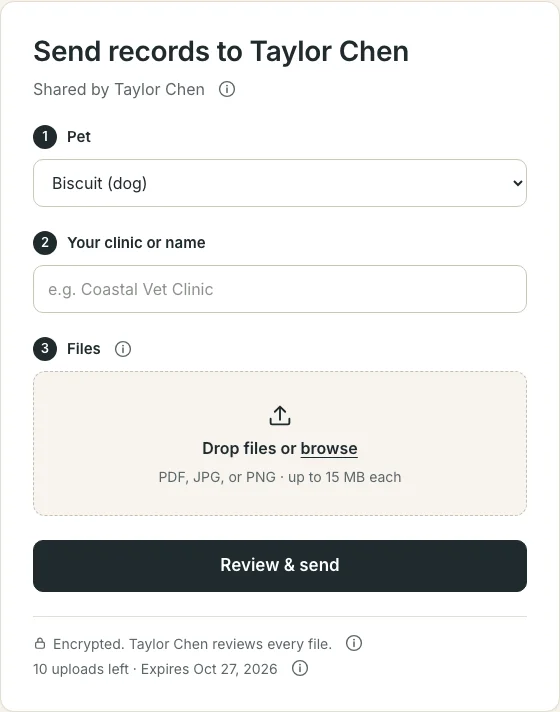
If requesting records is a job you repeat for a second clinic, an emergency hospital, or last year's specialist, MyPetVault keeps each request and everything that comes back in one place, organized into your pet's record instead of your inbox. Your first pet is free, so the next request costs nothing to try. Start with your first pet free, and let the next handoff be the last one you chase by hand.
Written for pet owners in the US & Canada. Rules and fees vary by location, so confirm the details with your clinic.
Common questions
How do I request my pet's records from a vet?
Contact the clinic that provided the care and ask, in writing, for the complete record: visit notes, vaccination history and rabies certificate, lab and imaging reports, and medication history. Use this page's email template, name any deadline, and ask for a copy to yourself as well as any receiving clinic. Confirm the files arrived and check them against your list.
How long does it take to get vet records?
Ask the clinic how long it expects your request to take. A few business days may be typical, but archived paper records can take longer, and legal timelines vary by location. Urgent requests, such as those for a sick pet or a referral, may move faster if you explain the urgency. If the promised date passes, follow up in the same email thread, naming the specific documents still missing.
Can a vet charge me for copies of my pet's records?
Often, yes. In many states a reasonable copying or administrative fee is allowed, and the rules on fees, formats, and timelines vary by state. Many clinics send PDFs at no charge as a courtesy. If a fee is quoted, ask what it covers before you pay or dispute it.
Can a vet refuse to give me my pet's records?
Outright refusal is uncommon. In many states, owners are entitled to copies of their pet's records or at least a summary, though details vary by state and situation. If refused, ask for the policy in writing; your state veterinary board can explain the rule where you live. This page is practical guidance, not legal advice.
What if my vet clinic has closed?
Look for a closure notice naming a successor practice or a records custodian, the person or company holding the files. Contact the successor practice first. Your state veterinary board does not hold records, but it can often explain how to locate the custodian. Give any new vet the records you do have, plus a list of what is missing.
Sources & further reading
Doing this in the app? Saving records help guide
Keep reading
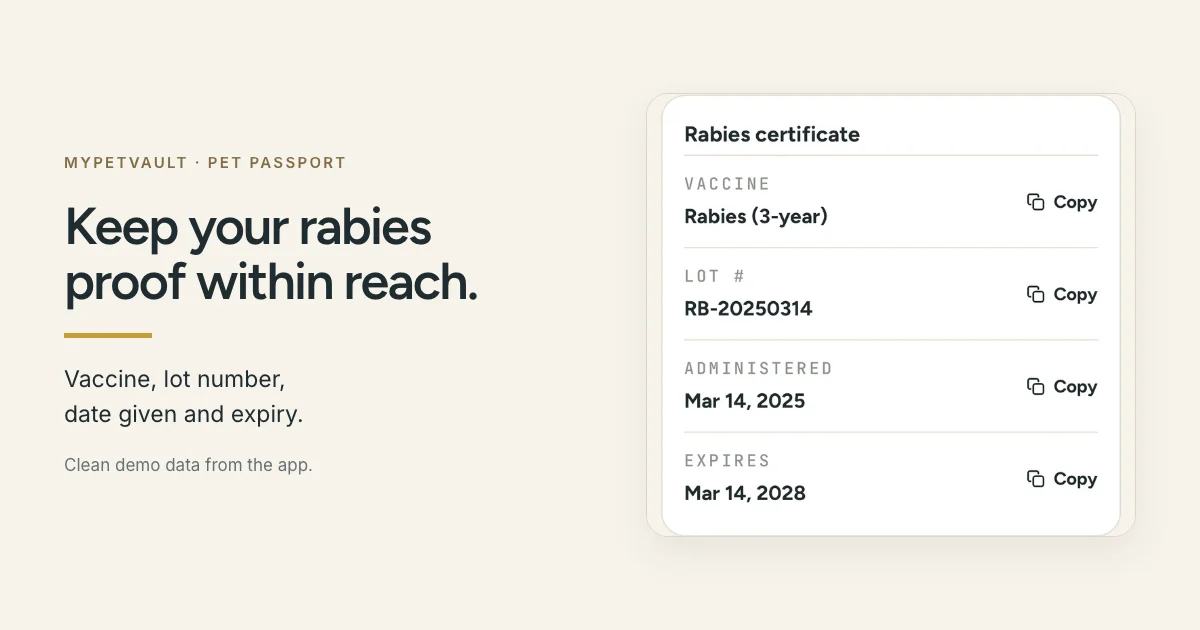 Lost Your Dog's Rabies Certificate? How to Get a Replacement (and Never Lose It Again)8 min read
 Switching Vets: The Complete Checklist for Moving Your Pet's Care8 min read