
The relationship ended; the dog didn't get that memo, and honestly, neither did either of you. So the pet still has two homes, two people, and one life to keep consistent. That can work. What makes it work isn't goodwill alone: it's that both homes run on the same information. Same vet records, same medication schedule, same feeding, same emergency plan: visible to both of you, not reconstructed from memory and text threads. This article is the logistics of that: the four things to keep identical, a hand-off routine that takes five minutes, and how to keep the records shared without sharing anything else.
Why shared care breaks down
Almost never because someone doesn't care. It breaks down over logistics:
- Two homes, two routines. Different feeding times, different rules, different treats, and the pet is the one who has to absorb the inconsistency.
- Records live with one person. The vet portal login, the rabies certificate, the vaccine history, usually in whichever home the pet lived in first. The other home is guessing.
- The double-dose problem. One home gives the evening medication, doesn't mention it, and the other home gives it again after the hand-off. Or each assumes the other did it, and nobody does. A clear medication hand-off helps avoid both mistakes.
- Hand-off texts get lost. "He seemed tired Tuesday" and "the vet said watch the lump" buried under two hundred other messages, in a thread neither of you wants to scroll through.
None of these need a fight to fix. They need a shared system.
The four things both homes need identical
- The vet, and the complete records
One primary vet (or at least one shared record if you use different clinics in different neighborhoods). Both homes should be able to pull up: vaccination history with due dates, the rabies certificate specifically, current medications and dosages, known conditions and allergies, and recent visit summaries. If the records are scattered across a portal, a drawer, and someone's email, our guide to what pet records to keep is the checklist to build from. Build it once, together, and both homes use the same copy from then on.
- Medications, with a visible given-log
A medication list is not enough. One way to help avoid a double dose is a log: which med, what dose, and when it was actually given, by whom. "Given at 8:05 AM" written where the other home can see it beats a text that may or may not have been sent. Any med with a schedule (daily pills, insulin, flea and heartworm prevention) belongs on the shared log, and the log gets checked before every dose, not after. A missing entry does not prove a dose was missed: check with the last caregiver before giving another dose. Follow the prescription instructions and ask your vet what to do if a dose may have been missed or repeated, as the FDA explains in its medication questions for pet owners.
- Feeding
Same food, same amount, same rough schedule, in both homes. Write it down once (brand, quantity, times, what's off-limits), and both homes follow the written version rather than each person's memory of it. Pets notice feeding chaos in their waistlines and their stomachs long before the humans notice it in each other.
- Emergency contacts and a plan
Agree on this before there's an emergency: which vet or emergency clinic, who gets called first, and who can authorize emergency treatment if the other person can't be reached. A pet who swallows something at 11 p.m. should not have to wait for a negotiation. Write the plan down where both homes can find it in seconds. Ask the clinic what written authorization it needs. Our pet emergency information sheet helps you put the contacts and care instructions together. The AVMA recommends keeping medical records, medication instructions, and treatment authorization available when someone else may need to obtain veterinary care.
A hand-off routine that takes five minutes
Every time the pet changes homes, the same small bundle changes hands with them:
- Records access confirmed: both homes can open the current records, not a copy from three months ago.
- Medications travel with a note: what's due during this stay, what was last given and when.
- Notes from the last stay: appetite, energy, anything odd, anything the vet said. Two or three sentences, written where they won't get buried.
- Supplies check: food, meds, and the leash that always ends up at the other house.
That's it. The routine is boring on purpose: boring means nothing depends on either of you remembering to mention something.
Example schedules (adapt freely)
There's no single right split; there's the split your pet handles well and your lives can sustain. Common shapes, as starting points:
- Weekdays / weekends: the pet is with one home Monday to Friday (nearer the usual vet, say) and the other home on weekends.
- Alternating weeks: a full week each, with one fixed hand-off day and time. Fewer transitions may suit some pets better; watch how your pet responds and ask your vet if changes in appetite or behavior concern you.
- 2-2-3 rotation: two days, two days, three days, then it flips. There are more hand-offs, but neither home goes long without the pet.
Whichever you choose, keep the hand-off day, time, and place consistent, and keep transitions calm and quick. The schedule is a logistics tool for the pet's stability, not a scoreboard.
The money part, said plainly
Shared care means shared costs: food, routine vet care, the occasional emergency. The system that keeps this from becoming its own argument is simple: keep every vet bill, receipt, and invoice in one shared place as it happens. One running record of what was spent, when, and on what beats trying to reconstruct six months of receipts from two people's inboxes when someone finally asks. Agree in advance on the basics: how routine costs split, and above what amount you'll check with each other before saying yes to a non-emergency expense. (Keep whatever record system you use honest and boring; this article is about record-keeping, not accounting software.)
A short note on the legal side
General information only, not legal advice: rules about pet ownership, separation, and written agreements depend on where you live and your circumstances. Sharing records in an app does not establish joint legal ownership or decide custody. Do not assume a care schedule settles either question. Two practical takeaways:
- A written pet-care agreement between the two of you is worth having, even if it's a page you both sign at the kitchen table. Consider including: the schedule and hand-off details, who the vet is and how major medical decisions get made, how costs are shared, emergency authority, and what happens if one person moves away.
- For anything contested or high-stakes, talk to a family lawyer in your state. This article can help you organize the care; it can't tell you your rights.
How MyPetVault handles the two-homes setup
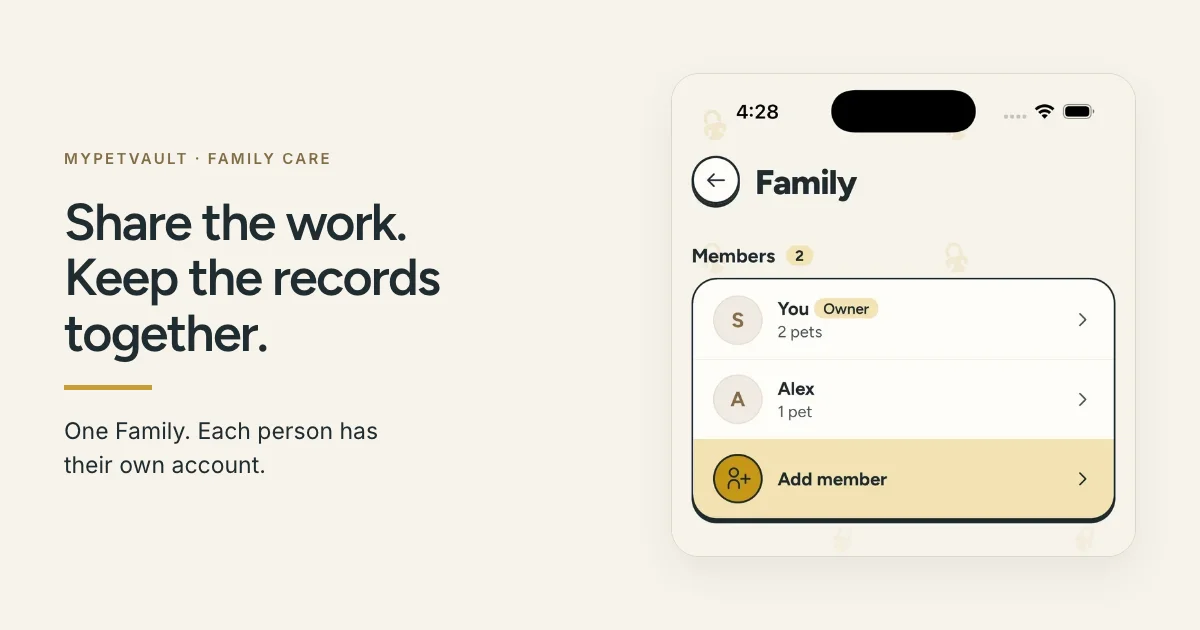
This is exactly the shape our family sharing was built for. In MyPetVault, the pet's owner creates a Family and invites the other person. A Family holds up to 6 people including the owner, and each member has their own account. A few boundaries that matter specifically for exes, stated factually:
- Separate accounts, shared pet care. Members see the family's pets with their records, documents, reminders, and Pet Passport while sharing is active. Each person signs in to their own account. The Family profile does not expose private account email or billing details, although members can see Family sharing status. Review documents before sharing, since they may contain personal information.
- Both homes can keep records current. Members can add and edit records, so whoever took the pet to the vet updates the file the other home sees.
- Control stays with the right owner. The Family organizer manages invitations and removals. Each pet's owner approves files a clinic sends for that pet and controls deletion of that pet. Other members can delete records they added themselves; they cannot delete someone else's pet. Joining a Family does not transfer pet ownership.
- Doses are logged, not texted. Confirm a medication dose as given when you administer it. The shared medication board shows who marked it and when, for example "Given by Alex · 8:05 AM," so both homes can check before the next dose.
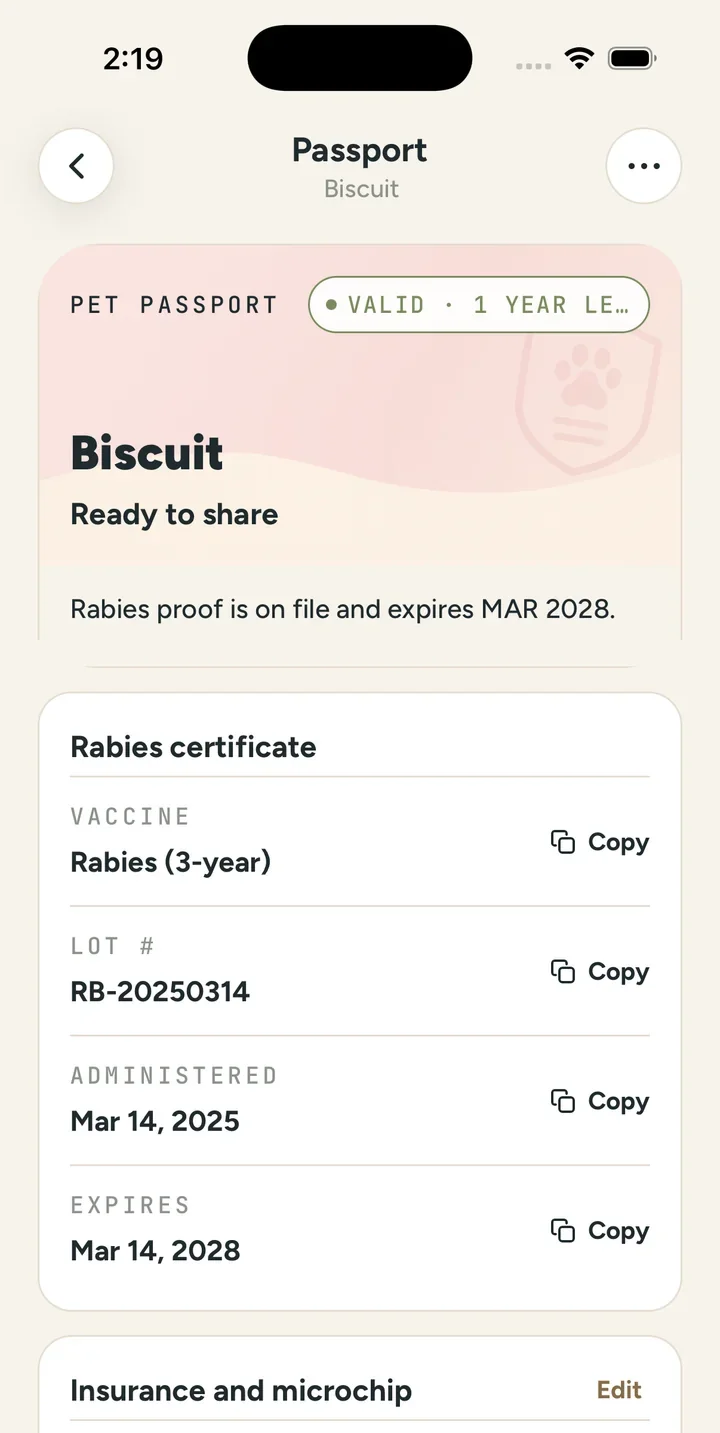
- Proof is ready at either home. Upload the rabies certificate to make the Pet Passport ready to share. Both homes can open the shared Passport while access is active and they have a connection. Records can also be sent by email; confirm which proof the boarding facility, groomer, or new vet accepts.
It's the same setup families use for parents, sitters, and grown kids; our guide to managing a family member's pet records from anywhere walks through that side of it. Members join free. Each member gets seven days of sharing from their first accepted or approved join with that organizer; leaving and rejoining does not restart it. The Family organizer's active Plus plan ($4.99/month) keeps sharing unlocked afterward. This does not give members their own Plus subscription or increase their personal upload and scanning limits. MyPetVault is a pet record app that keeps source documents with the records both homes rely on. Check that the file is complete and readable in both homes.
Common questions
Can we both see the dog's vet records if we live in different homes?
Yes, while shared access is active. If the records live in one shared place (in MyPetVault, a Family both of you belong to, each with your own account), both homes see the same records, documents, reminders, and Pet Passport, and either of you can add or edit records after a vet visit.
How do we make sure our pet doesn't get medication twice, or not at all?
Use a visible given-log instead of texts. Record each dose with the time and who gave it, and check the log before the next dose. In MyPetVault, the shared medication board shows the person and time for a confirmed dose. A missing entry does not prove the medicine was not given: check with the other caregiver. Ask your veterinarian what to do if a dose may have been missed or repeated.
Does my ex need my account or my payment details to share our pet's records?
No. Each person uses their own MyPetVault account. The Family profile does not expose private account email or billing details, although members can see Family sharing status. The organizer manages membership and paid sharing. Each pet's owner approves clinic files for that pet. Shared documents may contain personal details, so review what you share.
What should we put in a written pet-care agreement?
As general information: the schedule and hand-off routine, the primary vet, how routine and major medical decisions are made, how costs are shared, who can authorize emergency treatment, and what happens if one of you moves. Laws on pet custody vary by state; for anything contested, a family lawyer in your state is the right call.
Can a shared record help if we ever disagree about care?
A clear, dated record of vet visits, medications, and costs makes most day-to-day disagreements smaller, because you're both looking at the same facts. It isn't a legal document by itself, though; if things become contested, that's lawyer territory, not app territory.
Sharing a pet with someone you're no longer with asks something specific of both of you: keep the pet's world steady even though yours changed. The records are the easiest part of that to get right. MyPetVault keeps them in one place both homes can reach. The first pet is free, so you can set up the shared record here before the next hand-off, not during it.
Tommy Cao, founder of MyPetVault
Sources & further reading
Doing this in the app? Sharing & family help guide
Keep reading
 If Something Happened to Your Parent, Could You Find Their Dog's Records?9 min read
 You Don't Have to Manage Your Family's Pet Records Alone10 min read